

How To Get 11 With 4 4s
4 fours is a mathematical puzzle, the goal of which is to find the simplest mathematical expression for every whole number from 0 to some maximum, using only common mathematical symbols and the digit four. No other digit is allowed. Nearly versions of the puzzle require that each expression have exactly four fours, but some variations require that each expression have some minimum number of fours. The puzzle requires skill and mathematical reasoning.
The first printed occurrence of the specific problem of four fours is in Noesis: An Illustrated Magazine of Science in 1881.[1] A like problem involving arranging four identical digits to equal a certain amount was given in Thomas Dilworth's popular 1734 textbook The Schoolmaster's Banana, Being a Compendium of Arithmetics Both Practical and Theoretical.[ii]
Due west. W. Rouse Ball described information technology in the 6th edition (1914) of his Mathematical Recreations and Essays. In this book information technology is described as a "traditional recreation".[three]
Rules [edit]
In that location are many variations of 4 fours; their main difference is which mathematical symbols are immune. Essentially all variations at least allow addition ("+"), subtraction ("−"), multiplication ("×"), division ("÷"), and parentheses, as well every bit concatenation (due east.m., "44" is allowed). Most also allow the factorial ("!"), exponentiation (e.grand. "444"), the decimal bespeak (".") and the foursquare root ("√") performance. Other operations immune by some variations include the reciprocal function ("1/x"), subfactorial ("!" earlier the number: !4 equals 9), overline (an infinitely repeated digit), an arbitrary root, the square office ("sqr"), the cube function ("cube"), the cube root, the gamma function (Γ(), where Γ(x) = (x − 1)!), and percent ("%"). Thus


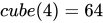


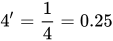
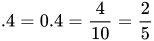

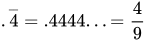
etc.
A common apply of the overline in this trouble is for this value:
Typically the successor function is non allowed since any integer higher up 4 is trivially reachable with it. Similarly, "log" operators are usually non allowed as they let a general method to produce whatsoever non-negative integer. This works by noticing three things:
one) It is possible to take square roots repeatedly without using any additional 4s
ii) A square root can also be written every bit the exponent (^(1/2))
3) Exponents accept logarithms as their inverse.
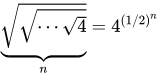
Writing repeated square root in this form nosotros can isolate n, which is the number of square roots:

We can isolate both exponents by using the base iv logarithm:

This logarithm can be thought of equally the answer to the question: "4 to what power gives me four to the one-half power to the n ability?"

so we are now left with:

and now we tin take a logarithm to isolate the exponent, n:

so, putting it all together:

At present, nosotros tin can rewrite the base (1/ii) with only 4s and the exponent (1/2) back to a square root:
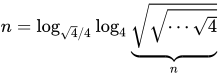
We have used four fours and at present the number of square roots nosotros add together equals whatever non-negative integer we wanted.
Paul Bourke credits Ben Rudiak-Gould with a unlike clarification of how 4 fours can be solved using natural logarithms (ln(n)) to represent any positive integer n as:
![n=-{\sqrt 4}{\frac {\ln \left[\left(\ln \underbrace {{\sqrt {{\sqrt {\cdots {\sqrt 4}}}}}}_{{n}}\right)/\ln 4\right]}{\ln {4}}}](https://wikimedia.org/api/rest_v1/media/math/render/svg/6496bdc75ab7bd794a25cc09b8e8c1e63e706800)
Additional variants (usually no longer called "four fours") supervene upon the set up of digits ("four, 4, 4, 4") with another set of digits, say of the birthyear of someone. For instance, a variant using "1975" would require each expression to use one 1, i nine, ane 7, and i five.
Solutions [edit]
Here is a gear up of 4 fours solutions for the numbers 0 through 32, using typical rules. Some alternate solutions are listed hither, although there are actually many more than correct solutions. The entries in blue are those that apply 4 integers 4 (rather than four digits four) and the bones arithmetics operations. Numbers without blue entries take no solution under these constraints. Additionally, solutions that echo operators are marked in italics.
0 = 4 ÷ 4 × 4 − 4 = 44 − 44 i = 4 ÷ 4 + 4 − 4 = 44 ÷ 44 2 = 4 −(4 + four)÷ four = (44 + 4)÷ four! 3 = (4 × 4 − 4)÷ iv = (4 + four + 4)÷ four 4 = 4 + 4 ×(4 − four) = −44 + iv!+ 4! 5 = (four × iv + iv)÷ four = (44 − 4!)÷ 4 6 = (4 + 4)÷ iv + iv = 4.four + four ×.4 7 = iv + 4 − iv ÷ 4 = 44 ÷ 4 − 4 eight = four ÷ iv × 4 + four = 4.four −.4 + 4 ix = 4 ÷ 4 + 4 + 4 = 44 ÷ 4 −√4 10 = (4- (iv ÷ 4))!+4 (4 + iv + 4)−√iv = (44 − 4)÷ 4 11 = (4!×√4 − 4)÷ 4 = √4 ×(4!−√four)÷ 4 12 = 4 ×(4 − 4 ÷ 4) = (44 + 4)÷ iv 13 = (4!×√4 + 4)÷ 4 = (four −.four)÷.4 + 4 14 = 4 × four − 4 ÷√4 = 4 ×(√4 +√4)−√4 15 = iv × 4 − four ÷ 4 = 44 ÷ 4 + 4 16 = 4 × 4 + 4 − 4 = (44 − four)×.4 17 = four × four + iv ÷ four = (44 + iv!)÷ iv 18 = 4 × 4 + iv −√4 = (44 ÷√4) − 4 nineteen = 4!−(4 + iv ÷ 4) = (4 + 4 −.4)÷.iv 20 = four ×(iv ÷ 4 + four) = (44 − iv)÷√4 21 = 4!− 4 + 4 ÷ four = (44 −√4)÷√4 22 = 4!÷ 4 + 4 × iv = 44 ÷(iv −√4) 23 = four!+ iv ÷ 4 −√4 = (44 +√four)÷√4 24 = 4 × 4 + 4 + 4 = (44 + four)÷√4 25 = iv!− 4 ÷ 4 +√four = (4 + four +√4)÷.4 26 = 4!+√4 + four - four 27 = iv!+√4 +(4 ÷ 4) 28 = (4 + four)× iv − 4 = iv!+ 4 + iv - 4 29 = four!+ iv +(4 ÷ iv) 30 = 4!+ 4 + 4 -√four 31 = four!+(four!+ 4)÷ 4 32 = iv × 4 + 4 × four
Annotation that numbers with values less than one are not usually written with a leading null. For example, "0.four" is usually written as ".4". This is considering "0" is a digit, and in this puzzle just the digit "4" tin can be used.
In that location are too many other ways to find the answer for all of these. A given number volition generally have a few possible solutions; any solution that meets the rules is adequate. Some variations prefer the "fewest" number of operations, or prefer some operations to others. Others merely prefer "interesting" solutions, i.e., a surprising manner to achieve the goal.
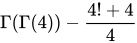
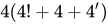
Certain numbers, such as 113, are particularly difficult to solve under typical rules. For 113, Wheeler suggests .[4] A non-standard solution is , where four' is the multiplicative changed of 4. (i.e. ) Another possible solution is , where and stand for the 14th and 127th multifactorials respectively, and should technically be denoted with that many assertion marks to adhere to the rules of the problem.


The use of percent ("%") admits solutions for a much greater proportion of numbers; for case, 113 = (√four + (√4 + 4!)%) ÷ (√iv)%.
Algorithmics of the trouble [edit]
This problem and its generalizations (similar the 5 fives and the vi sixes problem, both shown below) may exist solved by a unproblematic algorithm. The basic ingredients are hash tables that map rationals to strings. In these tables, the keys are the numbers being represented by some admissible combination of operators and the called digit d, due east.thou. iv, and the values are strings that incorporate the actual formula. In that location is one table for each number due north of occurrences of d. For case, when d=4, the hash tabular array for ii occurrences of d would contain the key-value pair 8 and iv+iv, and the ane for three occurrences, the key-value pair 2 and (4+iv)/4 (strings shown in assuming).
The task is then reduced to recursively calculating these hash tables for increasing n, starting from n=one and continuing up to e.g. n=four. The tables for north=i and n=2 are special, considering they comprise archaic entries that are not the combination of other, smaller formulas, and hence they must exist initialized properly, like so (for n=1)
T[4] := "four"; T[4/10] := ".4"; T[four/9] := ".4...";
and
T[44] := "44";.
(for n=2). Now there are two ways in which new entries may ascend, either as a combination of existing ones through a binary operator, or by applying the factorial or square root operators (which does non employ boosted instances of d). The first example is treated by iterating over all pairs of subexpressions that use a total of n instances of d. For example, when n=iv, nosotros would check pairs (a,b) with a containing one instance of d and b three, and with a containing 2 instances of d and b 2 as well. We would then enter a+b, a-b, b-a, a*b, a/b, b/a) into the hash table, including parenthesis, for n=4. Hither the sets A and B that incorporate a and b are calculated recursively, with n=1 and n=2 being the base case. Memoization is used to ensure that every hash table is merely computed once.
The second case (factorials and roots) is treated with the help of an auxiliary function, which is invoked every time a value v is recorded. This function computes nested factorials and roots of 5 up to some maximum depth, restricted to rationals.
The terminal stage of the algorithm consists in iterating over the keys of the table for the desired value of n and extracting and sorting those keys that are integers. This algorithm was used to calculate the five fives and six sixes examples shown below. The more than compact formula (in the sense of number of characters in the corresponding value) was chosen every time a key occurred more than once.
Extract from the solution to the 5 fives problem [edit]
139 = (((5+(v/5))!/5)-5) 140 = (.5*(5+(5*55))) 141 = ((5)!+((5+(v+.5))/.five)) 142 = ((v)!+((55/.5)/5)) 143 = ((((5+(five/5)))!-v)/5) 144 = ((((55/5)-v))!/v) 145 = ((5*(5+(5*5)))-5) 146 = ((5)!+((5/5)+(five*five))) 147 = ((5)!+((.5*55)-.5)) 148 = ((5)!+(.5+(.5*55))) 149 = (five+(((5+(5/5)))!+5))
Excerpt from the solution to the six sixes problem [edit]
In the table below, the notation .6... represents the value 6/9 or 2/3 (recurring decimal 6).
241 = ((.6+((6+6)*(6+half-dozen)))/.6) 242 = ((6*(6+(half dozen*6)))-(6/.6)) 243 = (6+((6*(.6*66))-.six)) 244 = (.6...*(6+(six*(66-vi)))) 245 = ((((half dozen)!+((6)!+66))/6)-six) 246 = (66+(6*((half dozen*6)-6))) 247 = (66+((6+((6)!/.6...))/6)) 248 = (six*(half dozen+(6*(vi-(.vi.../half dozen))))) 249 = (.6+(6*(half-dozen+((half dozen*vi)-.6)))) 250 = (((6*(6*6))-66)/.6) 251 = ((half dozen*(six+(vi*six)))-(six/6))
See also [edit]
- Krypto (game)
References [edit]
- ^ Pat Ballew, Before at that place were Four-Fours, there were iv threes, and several others, Pat'sBlog, 30 Dec 2018.
- ^ Bellos, Alex (2016). Tin Yous Solve My Problems?: A casebook of ingenious, perplexing and totally satisfying puzzles. Faber & Faber. p. 104. ISBN978-1615193882.
...It contains the following puzzle. 'Says Jack to his brother Harry, "I tin place four threes in such manner that they shall brand just 34; can y'all practise then too?"'
- ^ Ball, Walter William Rouse. Mathematical Recreations and Essays, page fourteen (sixth ed.).
- ^ "The Definitive Four Fours Answer Key (past David A. Wheeler)". Dwheeler.com.
External links [edit]
- Bourke, Paul. "Four Fours Problem".
- Carver, Ruth. "Four Fours Puzzle". at MathForum.org
- "4444 (Four Fours)". Archived from the original on 2011-08-02. Retrieved 2010-06-04 . Eyegate Gallery.
- four4s on GitHub
- "Online Implementation of the Four Fours Game".
Source: https://en.wikipedia.org/wiki/Four_fours
0 Response to "How To Get 11 With 4 4s"
Post a Comment